
Skip to content

Calculated planetary weather · noon UTC

Don’t guess at the week. See its turning points.

A living map of exact-aspect samples, Moon changes, sign ingresses, and retrograde stations—calculated from the sky, then translated into plain English.

The period in one answer

From November 17 through November 23, 2025, the Moon moves from Libra to Capricorn. The highest-priority calendar marker is New Moon in Sagittarius on November 20. Each day is computed at noon UTC from geocentric tropical longitudes, and the notes beside them describe the symbolic theme of that geometry.

Moon in Libra 7% lit 5 retrograde
Transit intensity Relative signal, not a good/bad score

kept in this browser.

The sky, day by day

Seven days. Different weight.

Intensity shows how concentrated the measured sky is—not whether a day is lucky or difficult. Open a date for every planetary degree behind the summary.

100 · Peak

Libra Moon

Moon square Jupiter

Closest daily sample · 0°04' orb

Moon in Libra, 7% illuminated. The ninety-degree geometry emphasizes friction, adjustment and the need to direct effort deliberately.

☽ □ ♃ ☉ △ ♄ ☉ △ ♃

100 · Peak

Scorpio Moon

Jupiter trine Saturn

Closest daily sample · 0°14' orb

Moon in Scorpio, 3% illuminated. The one-hundred-twenty-degree geometry describes an easier flow that can be useful when it is noticed and used on purpose.

♃ △ ♄

90 · Peak

Scorpio Moon

Mercury opposition Uranus

Closest daily sample · 0°01' orb

Moon in Scorpio, 1% illuminated. Two planetary functions face one another across the chart, making contrast and competing priorities easier to see.

☿ ☍ ♅ ☿ △ ♆

100 · Peak

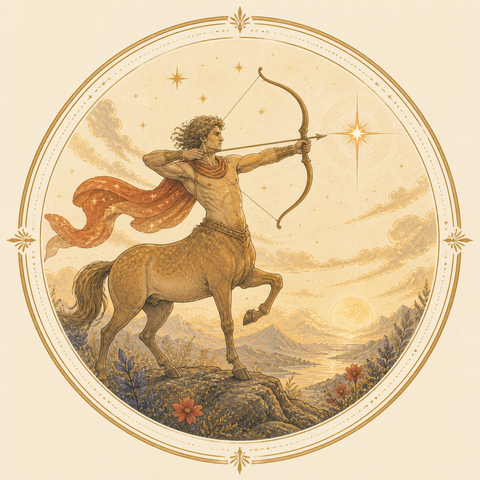
Sagittarius Moon

New Moon in Sagittarius

0% illuminated · noon UTC

Moon in Sagittarius, 0% illuminated. The Moon reaches the darkest daily sample of the lunation, aligned with the Sun in ecliptic longitude.

☉ ☌ ☿ ☽ ⚹ ♇

100 · Peak

Sagittarius Moon

Sun opposition Uranus

Closest daily sample · 0°01' orb

Moon in Sagittarius, 1% illuminated. Two planetary functions face one another across the chart, making contrast and competing priorities easier to see.

☉ ☍ ♅ ☽ ☌ ♂ ♅ ⚹ ♆

100 · Peak

Sagittarius Moon

Sun enters Sagittarius

Sign ingress · noon UTC sample

Moon in Sagittarius, 4% illuminated. Sun has crossed a thirty-degree zodiac boundary, beginning a new sign chapter in the public sky.

☽ □ ♄ ☿ △ ♄

91 · Peak

Capricorn Moon

Sun sextile Pluto

Closest daily sample · 0°18' orb

Moon in Capricorn, 9% illuminated. The sixty-degree geometry describes an opening or opportunity that remains optional rather than demanding attention.

☉ ⚹ ♇
Peak Active Steady Quiet

Intensity combines closeness, the number of active aspects, and major calendar markers. It never means “good” or “bad.”

Dates worth circling

The turning points, with the math attached.

These cards are ordered by measured weight, not dramatic wording. Each one states the date, geometry, orb or detection rule, and what the symbol can—and cannot—tell you.

Nov 20 Thu

01 · 0% illuminated · noon UTC

New Moon in Sagittarius

The Moon reaches the darkest daily sample of the lunation, aligned with the Sun in ecliptic longitude.

Verifiable lineThe New Moon falls in Sagittarius on November 20, 2025, with 0 percent illumination at the noon UTC sample.

92 signal
Nov 22 Sat

02 · Sign ingress · noon UTC sample

Sun enters Sagittarius

Sun has crossed a thirty-degree zodiac boundary, beginning a new sign chapter in the public sky.

Verifiable lineBy the noon UTC sample on November 22, 2025, Sun is in Sagittarius; the sign boundary was crossed after the preceding day’s noon sample.

88 signal
Nov 19 Wed

03 · Closest daily sample · 0°01' orb

Mercury opposition Uranus

Two planetary functions face one another across the chart, making contrast and competing priorities easier to see.

Verifiable lineAt noon UTC on November 19, 2025, Mercury opposition Uranus measures 0°01' from exact in geocentric tropical longitude.

84 signal
Nov 21 Fri

04 · Closest daily sample · 0°01' orb

Sun opposition Uranus

Two planetary functions face one another across the chart, making contrast and competing priorities easier to see.

Verifiable lineAt noon UTC on November 21, 2025, Sun opposition Uranus measures 0°01' from exact in geocentric tropical longitude.

84 signal
Nov 17 Mon

05 · Closest daily sample · 0°04' orb

Moon square Jupiter

The ninety-degree geometry emphasizes friction, adjustment and the need to direct effort deliberately.

Verifiable lineAt noon UTC on November 17, 2025, Moon square Jupiter measures 0°04' from exact in geocentric tropical longitude.

83 signal
Nov 20 Thu

06 · Closest daily sample · 0°16' orb

Sun conjunction Mercury

The two planetary functions occupy nearly the same degree, concentrating their themes rather than balancing them.

Verifiable lineAt noon UTC on November 20, 2025, Sun conjunction Mercury measures 0°16' from exact in geocentric tropical longitude.

82 signal
Nov 21 Fri

07 · Closest daily sample · 0°22' orb

Moon conjunction Mars

The two planetary functions occupy nearly the same degree, concentrating their themes rather than balancing them.

Verifiable lineAt noon UTC on November 21, 2025, Moon conjunction Mars measures 0°22' from exact in geocentric tropical longitude.

81 signal
Nov 22 Sat

08 · Closest daily sample · 0°41' orb

Moon square Saturn

The ninety-degree geometry emphasizes friction, adjustment and the need to direct effort deliberately.

Verifiable lineAt noon UTC on November 22, 2025, Moon square Saturn measures 0°41' from exact in geocentric tropical longitude.

79 signal
Nov 17 Mon

09 · Closest daily sample · 0°04' orb

Sun trine Saturn

The one-hundred-twenty-degree geometry describes an easier flow that can be useful when it is noticed and used on purpose.

Verifiable lineAt noon UTC on November 17, 2025, Sun trine Saturn measures 0°04' from exact in geocentric tropical longitude.

76 signal

The three strongest days

Plan attention, not fear.

A high signal means more geometry is concentrated around one date. It can be easy or demanding. The useful response is extra attention—not canceling a meeting because a planet made a square.

  1. 1
    Monday, November 17

    Moon square Jupiter

    100
  2. 2
    Tuesday, November 18

    Jupiter trine Saturn

    100
  3. 3
    Thursday, November 20

    New Moon in Sagittarius

    100

Built to be checked

A forecast with its working left in.

01

Measure

Every day starts with geocentric tropical planetary longitudes calculated at 12:00 UTC.

02

Compare

Adjacent days expose ingresses, apparent stations, lunar peaks, and the closest daily aspect sample.

03

Rank

Closeness and event type determine emphasis. Dramatic language does not change the score.

04

Interpret

Astronomy is labeled as calculation; symbolic meaning is labeled as reflection, never certainty.

Read the complete calculation model, source series, tolerances, and limitations on How we calculate. Inspect the raw positions for any date in Today’s sky.

The public sky is only half the map

Find out which of these dates are actually yours.

Add your birth minute and place once. The private overlay replaces general planetary weather with exact contacts to your Sun, Moon, Venus, Mars, and the rest of your chart.

Clear answers

Frequently asked questions

What are the major astrology transits in November 17–23, 2025?
The weekly calendar ranks the exact-aspect samples, planetary sign changes, apparent retrograde stations, and New or Full Moon markers calculated for November 17–23, 2025. The dated event cards above are the current answer; they are generated from the planetary positions rather than copied from a general forecast.
What is an astrology transit calendar?
An astrology transit calendar places changing planetary positions on a timeline. The public calendar shows transits in the sky that are shared by everyone. The private overlay adds a second comparison: each moving planet is measured against the exact planetary degrees in one birth chart.
How are the dates in this transit calendar calculated?
MyMysticDay calculates geocentric tropical longitudes on its own server and samples the sky at noon UTC each day. It compares adjacent daily samples to identify sign changes, apparent direction changes, lunar illumination peaks, and the date on which an aspect is closest to exact. The displayed date is a daily planning marker, not a claim that every event perfects at noon.
What does “orb” mean in the calendar?
Orb is the angular distance between a measured aspect and mathematical exactness. An orb of 0°20′ is twenty arcminutes from exact and is closer than an orb of 1°10′. The calendar prints the measured orb so readers can distinguish a tight contact from a broad background influence.
Why can a personal transit forecast differ from a zodiac horoscope?
A zodiac horoscope usually starts with one shared sun-sign category. A personal transit forecast compares the current sky with the degrees of your Sun, Moon, Mercury, Venus, Mars, and the rest of your natal chart. Two people with the same sun sign can therefore have different close contacts and different peak dates.
Are personal transit calendars public or indexed by search engines?
No. Public weekly and monthly sky calendars are indexable because they contain no birth data and are identical for every reader. A personal calendar is served with noindex and no-store instructions, uses a canonical link to the private entry page, and does not place a birth date, birth time, or birthplace in its URL.
Does a transit predict that a specific event will happen?
No. The astronomical position and angular separation are calculations; the meaning attached to them is a symbolic framework for reflection. A transit cannot guarantee an event, reveal another person’s thoughts, or replace qualified medical, legal, financial, safety, or mental-health advice.