
- Element
- Air
- Arcana
- Minor · Swords
- Attribution
- the Sun in Gemini
- Feeling shows as
- Words and conclusions
- Stage
- The full extent
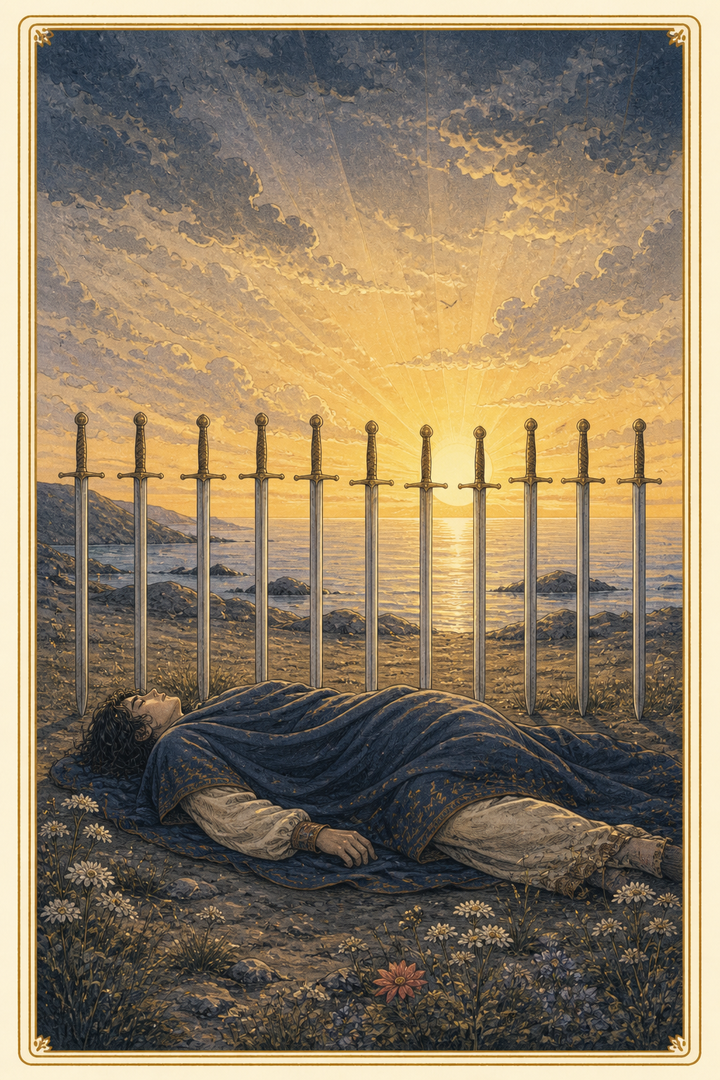
Ten of Swords
as feelings
They feel that this is finished, and the ending was not gentle.
Why
The Ten of Swords is the end of the line in the hardest suit. It is a air card, so what it reports is what they have concluded and are prepared to say rather than the whole of what they feel.

Upright and reversed
What it is like to hold this feeling.
A reversal is not the opposite of the upright card. It blocks it, delays it, turns it inward or takes it too far, and which of those depends on the kind of card it is.
Upright
The Ten of Swords is the end of the line in the hardest suit. Something has collapsed completely — a belief about the relationship, a trust, a version of events — and they are not looking for a way back because from where they stand there is not one. The card is dramatic and it is also final in a way that is, in its own bleak fashion, restful: nothing more can be taken from here. Its one mercy is that the Ten is the last card, and the suit starts again after it.
Reversed
Reversed, the ending is either being survived or being dramatised. Sometimes it is recovery beginning at the lowest point; sometimes it is somebody who has decided this is a catastrophe and is some distance from the evidence.
Reversed late in a suit, the card usually reads as excess or as refusal to finish. Either the feeling has been taken past its useful point, or a conclusion is being avoided because reaching it would mean something.
Why the suit decides the answer
Air does not feel the way the other three do.
The same rank in two suits describes two genuinely different states. This is the largest single fact about any card in a feelings position — larger than the picture on it.
Air thinks about what it feels. A Swords card in a feelings position is reporting the account somebody has constructed — what they have concluded, what they have told themselves, what they are prepared to say out loud — rather than the raw state underneath it.
You will know a Swords feeling by the presence of a verdict. These cards come with reasoning attached, and the reasoning is doing at least as much work as the emotion is.
Air mistakes its conclusions for facts. A Swords feeling is only as sound as the information it was built from, and this suit contains the deck's best cards for a story told inwardly until it became true.
Where the feeling is in its arc
The full extent.
At a Ten the feeling has reached the end of what this suit can do with it. Everything the element had to give has been given.
A Ten is a threshold rather than a verdict. It is the end of this particular thing and not the end of the subject, and treating it as final closes a question it was opening.
the Sun in Gemini, the third decan. the Sun is what colours the feeling and Gemini is the temperature it runs at, which is why this card cannot mean quite what the ones either side of it mean. The two elements are the same, so nothing here is moderated: this is air undiluted, at its most characteristic and its least balanced.
The same card, four situations
It does not mean the same thing for an ex as it does for a stranger.
Each reading below is built from two things that differ card to card: what the element does to a feeling, and how far along that feeling is.
Someone you have just met
For a new connection, Swords means somebody is assessing rather than falling. That is colder than it sounds and it is not bad news: a judgement formed early tends to hold. A number this late in a suit is doing something odd at the start of a connection: it describes a feeling further along than the relationship is, which is worth noticing.
A relationship you are already in
Inside an established relationship, Swords is almost always about what has been said or withheld. The suit measures the state of the conversation, and in a long relationship the conversation is frequently the whole of the problem. Inside something already established, a Ten is a threshold rather than a verdict. It is the end of this particular thing and not the end of the subject, and treating it as final closes a question it was opening.
Someone who ended it, or who you ended it with
For a connection that has ended, Swords is the suit of the post-mortem. It describes somebody still working out what happened, and that process can run for a very long time without producing a move. This late in the suit the feeling has run most of its course, so what the card describes is a settled state rather than an open question.
A feeling neither of you has said out loud
When nothing has been said, a Swords card is the most literal of the four: the silence is the subject. Something has been thought through and not stated, and the withholding is deliberate. Applied to something unspoken, at a Ten the feeling has reached the end of what this suit can do with it. Everything the element had to give has been given.
The part most readings skip
What this card cannot tell you.
A feelings position is the one place a reader most wants to be told what they were hoping for, which is exactly why it is the easiest to misread.
- A card describes a quality of feeling. It does not identify a person, confirm that they are thinking about you at this moment, or guarantee what they will do next — and any reading that offers those things is selling certainty the deck does not contain.
- Feelings positions are the ones readers most want a particular answer from, which is exactly why they are the easiest to misread. If a card seems to confirm precisely what you hoped, that is the moment to check it against what has actually happened.
- One card is one input. A feeling that contradicts everything a person has done for six months is a card that needs the rest of the spread, not a card that has revealed a secret.
Keep going
A feeling is one position in a spread.
The full meaning of Ten of Swords — upright, reversed, love, career, money and the symbolism the painting carries — is on its own page. If you have not drawn a card yet, the reading below deals a real one.